Google Introduces One-Click Google Tag Gateway via Google Cloud
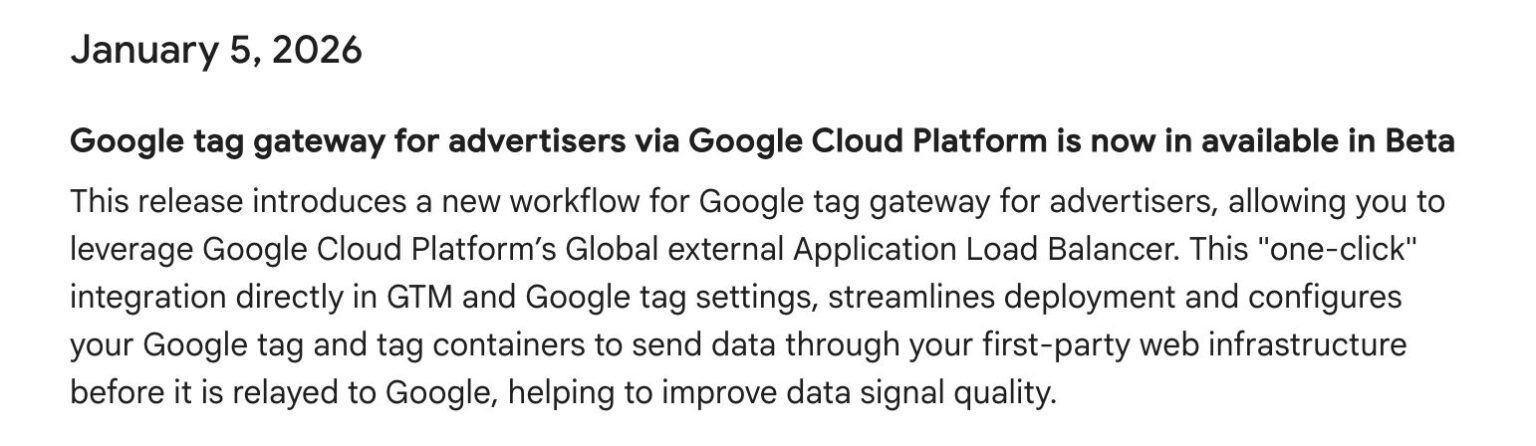
Google has rolled out a beta integration for Google Tag Gateway on Google Cloud Platform (GCP), making first-party tagging significantly easier for advertisers and marketers navigating today’s privacy-first web.
This new integration allows businesses to deploy Google Tag Gateway using a one-click workflow directly inside Google Tag Manager and Google tag settings, removing much of the technical friction that previously made first-party tagging difficult to adopt.
What’s New?
The Google Cloud Tag Gateway integration leverages Google Cloud’s Global External Application Load Balancer to route tag traffic through an advertiser’s own first-party domain before it’s sent to Google.
By keeping tagging requests within first-party infrastructure, advertisers can:
- Improve data accuracy and signal quality
- Increase resilience against ad blockers
- Reduce impact from browser privacy features like Apple Intelligent Tracking Prevention
Why This Matters for Advertisers
As third-party cookies and trackers continue to disappear, maintaining reliable measurement has become a major challenge. First-party tagging is one of the most effective solutions — but historically, it required complex setups and technical expertise.
With this GCP integration:
- Deployment is faster and simpler
- Measurement signals are more stable
- Tracking becomes more future-proof
For teams already using Google Cloud, this update dramatically lowers the barrier to adopting server-side and first-party tagging strategies.
Industry Reaction
Digital analytics expert Simo Ahava, co-founder of Simmer, shared insights about the launch on LinkedIn, noting that the integration automatically provisions an External Application Load Balancer and backend services to handle Google Tag Gateway requests.
He also highlighted that placing Google’s tagging technologies behind a same-site, same-origin first-party host helps them survive restrictive browser environments more effectively.
The Bigger Picture
Previously, Cloudflare was the only automated deployment option for Google Tag Gateway, while other CDNs required manual configuration. By adding native Google Cloud support, Google is clearly signaling stronger commitment to first-party data strategies.
Bottom Line
While still in beta, the Google Cloud Tag Gateway integration is a meaningful step forward for advertisers who want stronger measurement, better compliance, and long-term tracking stability in a privacy-constrained digital ecosystem.
Source Credit: Adapted and summarized from industry reporting and insights originally shared by Google and Simo Ahava.